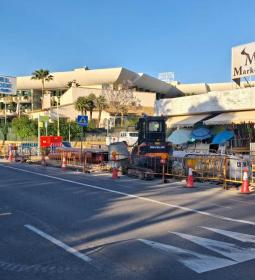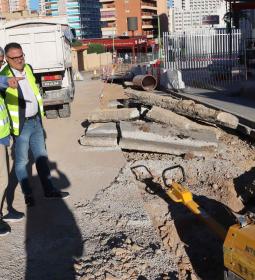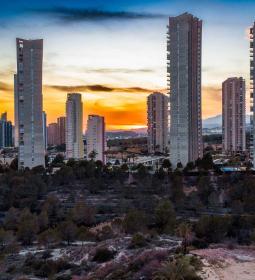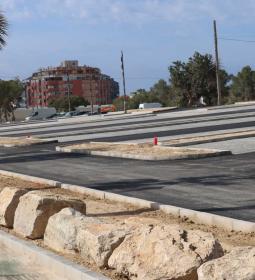
The opening of the exhibition, promoted by the City Council, Veolia and INFORMACIÓN newspaper, has brought together irrigators, technicians and other people related to the water cycle
Benidorm commemorates World Water Day with an open-air exhibition on its water management since the 'water crisis'
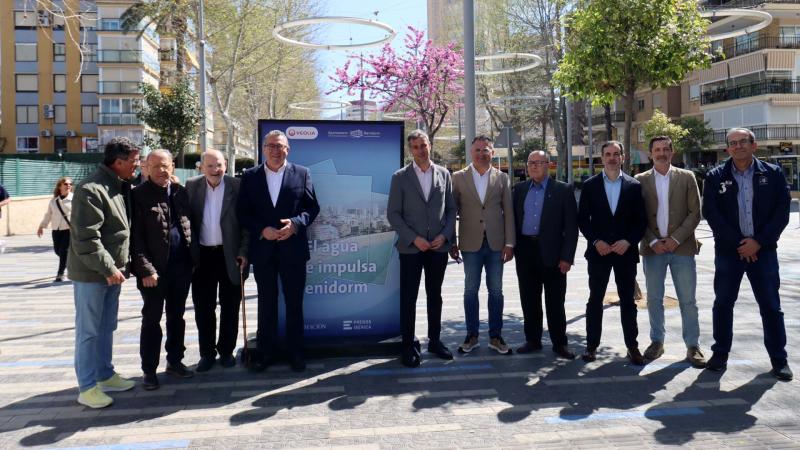
Benidorm commemorated World Water Day this Sunday, March 22nd, with the opening of an open-air exhibition that reviews key moments in the city's water history, from the so-called "water crisis" of 1978 to the present day. The exhibition, entitled "El agua que impulsa Benidorm," is located at number 1 Avenida del Mediterráneo and extends along this thoroughfare through some fifteen advertising panels (mupis) that highlight the main projects undertaken in the city over the last half-century, accompanied by related news articles published in INFORMACIÓN newspaper, one of the exhibition's organizers along with Benidorm City Council and the concessionary company Veolia.
The mayor of the city, Toni Pérez; the regional director of Veolia, Jordi Azorín; and the director of the newspaper, Toni Cabot, were present at the opening. The curator of this exhibition, journalist Vicente Zaragoza Martínez, was responsible for presenting the exhibition and guiding the attendees on this institutional visit, which was well-attended. Among them were the Councillor for the Water Cycle in Benidorm and regional deputy, José Ramón González de Zárate; the manager of Veolia in Benidorm and the surrounding area, Ciriaco Clemente; as well as numerous members of the local government, municipal and company engineers and technicians, irrigators, and other stakeholders involved in water management.
“Speaking about Benidorm is to speak of water,” the mayor emphasised, noting that the city has long grappled with water, especially with water scarcity. In this regard, he recalled Beatriu Fajardo de Mendoza, who spearheaded infrastructure projects such as the Séquia Mare, which in 1666 brought water to Benidorm and, consequently, enabled its repopulation. and also to other people who dedicated themselves to guaranteeing the city's water supply. Among them, more recently, mayors like Rafael Ferrer Meliá and municipal engineers and workers like José Ramón García Antón, Francisco Santiago, and Juan José Sánchez, who for 40 years was foreman of the municipal technical services.
Toni Pérez highlighted “the enormous efforts Benidorm has made throughout its history to obtain water from where there was none, to give it the best treatment, and, with an investment capacity that is unparalleled in relation to our population, to make the performance of our network one of the highest in the world today.”
“One of the city’s great miracles is precisely how it went from a Séquia Mare (main irrigation canal) to the Lower Algar Canal; how the Lower Canal was reconciled and transitioned to a Marina Baixa Water Consortium; and how our irrigators understood that the important thing was human consumption and how, with large infrastructures, they have been able to combine and deliver water where it was needed and where it is produced,” the mayor stated, emphasizing that “we will be able to see all of this throughout this exhibition.”
For his part, the exhibition's curator and journalist, Vicente Zaragoza, recalled that “Benidorm has always had a special relationship with water: first, we had to learn to manage it, creating a flood prevention plan because every time it rained, the city flooded, as it's located at the end of large ravines like l’Aigüera, Xixo, and Barceló; and then, the drought” that in the late 1970s left the city without water and forced them to rely on Navy ships, which generated a population and tourism crisis.
From there, Zaragoza detailed all the work that was carried out to create a network to transfer water from one side of the region to the other to ensure the supply for the population and the allocations from irrigators, something he wrote extensively about during his time as a journalist for INFORMACIÓN.
The editor of this newspaper also recalled that this exhibition “has been in the works for a long time to highlight all the work that was carried out long ago to ensure that Benidorm would never again lack water,” something that was achieved because “there were very determined people and a strong and powerful company that joined in this good management,” Toni Cabot pointed out.
For his part, the regional director of Veolia, Jordi Azorín, said, “It seems incredible that in 1978 Benidorm had no water and that 40 years later it became a global example of water management.” He also highlighted all the investments that have been made in recent years to reinforce this efficiency and to continue improving and innovating in water management; among other things, with the opening of centres like Dinapsis.
Benidorm Water Week Program
The opening of this exhibition is the first of the events programmed by Benidorm City Council and Veolia for Water Week, which will run from this Sunday until Wednesday, April 1st.
Among these activities, tomorrow, Monday the 23rd, there will be an escape room activity for schoolchildren and a visit to the wastewater treatment plant (WWTP) for schools and institutes. The following day, the municipality's Water Footprint project will be presented at BeCiti Hub. This presentation for businesses and media will take place at 10:30 a.m. There will also be school performances of the play "La gota viajera" at 10:00 a.m. and 11:30 a.m., explaining the water cycle to students.
On Wednesday the 25th, a technical workshop for schools and institutes has been organised, including a visit to the treatment plants and educational water tastings. It will run from 8:45 a.m. to 11:00 a.m. On Thursday, guided tours and tastings will continue, and special radio programs about the water cycle will be broadcast. On Friday, March 27, there will also be live radio from Veolia's digital hub and school visits to the wastewater treatment plant and the Séquia Mare open-air museum.
On Tuesday, March 31, the focus will be on reclaimed water, with a visit planned to the construction project underway in the western part of the city. The program will conclude on Wednesday, April 1, with the presentation of Sequia Mare Interpretation Centre, which will take place at Séquia Mare Hostel.