
More than 11,300 children and teenagers will return to classrooms at Benidorm’s schools and secondary schools tomorrow
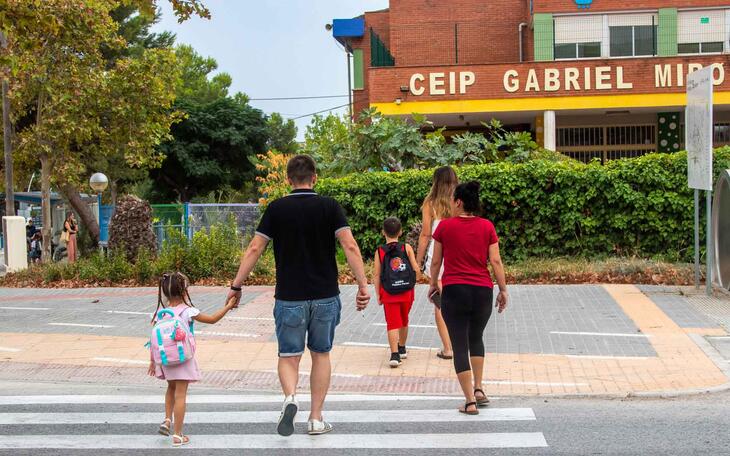
The City Council is allocating more than €750,000 in financial support to help families cover back-to-school expenses, as well as students’ educational and transport needs
The Department of Education has opened six additional Primary School classes to accommodate the relentless growth in enrolment, along with two new UECO classrooms for students with specific educational needs.
Some students at IES Pere Maria Orts i Bosch will attend classes at the Municipal Study Centre during the first few days of the school year, less than 100 metres from the school, while work is completed on the new classroom building.
More than 11,300 children and teenagers in Benidorm will return tomorrow to classrooms in the city’s public, state-subsidised and private schools and secondary schools, marking the start of the 2026-2027 academic year, which will run from September 9 to June 18, 2027.
Of these students, around 1,700 will be enrolled in the second cycle of Early Childhood Education, more than 4,000 in Primary Education, 3,000 in Compulsory Secondary Education (ESO), and around 2,700 in Baccalaureate and basic, intermediate and advanced vocational training programmes. These courses are taught across the city’s 14 publicly funded schools, five secondary schools and one private school. Councillor for Education Maite Moreno gave the figures and publicly wished students, teachers and families a happy start to the new school year.
Among them are just over 500 three-year-olds who will be entering the education system in the second cycle of Early Childhood Education. A further 90 two-year-olds will join the P2 programme, with dedicated classrooms available at five local schools: CEIP Serra d’Aitana, CEIP Mestre Gaspar López, CEIP Vasco Núñez de Balboa, CEIP Puig Campana and CEIP La Cala.
The city has also recorded a “significant increase in student numbers” this academic year. In response to the continued growth in enrolment, the Regional Department of Education has authorised six additional Primary Education classes at four public schools: Ausiàs March, Serra Gelada, Serra d’Aitana and Gabriel Miró, Councillor Moreno explained.
As for Secondary Education, the school council of IES Pere Maria Orts i Bosch agreed this afternoon that some students will attend classes during the first few days of the new school year at the Carmen García Santos Municipal Study Centre, located directly opposite the secondary school, less than 100 metres away.
Moreno explained that “work on the new classroom building is virtually complete, ahead of the original schedule, which had set October as the completion date.”
“The progress of the works,” she added, “has allowed the temporary classrooms where some students have been taught since 2010 to be dismantled, restoring part of the recreational and sports areas they occupied. However, following the breakage of two panes of glass in the walkway connecting the two buildings, classes cannot begin tomorrow in this part of the school,” as confirmed by the Education Inspectorate.
For this reason, the school council has agreed to keep teaching for Year 7 and Year 8 students and vocational training students at the secondary school itself, while Year 9 and Year 10 students and those in Baccalaureate will attend classes at the Municipal Study Centre during the first few days, while the remaining work is completed.
With the approval of the Education Inspectorate, the school council has agreed that Year 7 students and vocational training students will begin their regular classes as scheduled. The remaining students will start on Monday: Year 8 students will attend classes at the secondary school itself, while Year 9, Year 10 and Baccalaureate students will be taught at the Study Centre.
The councillor also recalled that “the Generalitat Valenciana has made a major investment to complete this school after years of delays, with a budget of almost €13 million and an 18-month construction period.” She added that the works “were originally due to be completed by the end of October, but this deadline will now be brought forward to the coming weeks.”
Among the other new developments for the academic year, Moreno highlighted the opening of two new UECO classrooms — specialist units within mainstream schools — to support the educational inclusion of students with specific needs at Puig Campana and Miguel Hernández primary schools.
With these additions, Benidorm now has a total of eight UECO classrooms in public primary and secondary schools. Four are located at El Murtal, Mestre Gaspar López, Ausiàs March and Gabriel Miró primary schools, while another is available at Mediterrània Secondary School. The city also has an educational inclusion programme at Beatriu Fajardo de Mendoza Secondary School.
Comprehensive refurbishment of Ausiàs March School
Over the coming days, almost in parallel with the start of the new school year, work will begin on the comprehensive refurbishment of Ausiàs March Public Infant and Primary School. The project was awarded by Benidorm City Council in August, with a budget of just over €2.4 million and a 12-month completion period.
The Councillor for Education explained that, as already “agreed with the school council and teaching staff, a schedule will be established to ensure that the works can be carried out alongside the school’s teaching activities.” Moreno added that “last week, a meeting was called for Thursday, September 17, bringing together municipal technicians, representatives of the school community and the contractor” to address the coordination of the works.
Moreno recalled that the project will involve a comprehensive refurbishment of the school, covering all areas, facilities and building systems, both in the Infant Education block and the Primary Education area. The works will include structural improvements, upgrades to heating and cooling systems, enhanced accessibility, the renewal of electrical and telecommunications installations, and improvements to playgrounds and sports areas, among other measures.
Education grants
Following the approach taken in previous years, Benidorm City Council has once again launched a range of grants to support families and help ease the financial burden that the start of the new school year represents for many households. These schemes will “involve a total investment of more than €750,000 in direct financial assistance for people registered as residents of Benidorm,” Councillor Maite Moreno explained.
One of these schemes provides support for the purchase of school supplies for students in the second cycle of Early Childhood Education, for which the City Council has allocated €70,000. The councillor recalled that last year, 1,006 children aged between three and five received this grant, amounting to €63 per student. So far this year, the Department of Education has already approved 830 individual grants worth a total of €52,290. However, “the application period remains open until September 30, so families can still apply,” Moreno added. The City Council expects the number of beneficiaries to once again exceed 1,000.
The Local Government Board has also approved a €175,000 allocation to subsidise school transport for Early Childhood, Primary and Secondary Education students attending the Salt de l’Aigua educational complex. The complex is home to Mestre Gaspar López and Gabriel Miró public primary schools, as well as Pere Maria Orts i Bosch, Bernat de Sarrià, L’Almadrava and Beatriu Fajardo secondary schools, together with students from IES Mediterrània.
The scheme is also extended to students in post-compulsory education and complements the grants provided by the Generalitat Valenciana. Moreno explained that the allocation “has increased this year from €159,000 to €175,000 due to the rise in student numbers we are seeing across all levels of education.” She added that the grants, which benefited more than 750 students last academic year, “cover 100% of the cost of the service for all students in the second cycle of Early Childhood Education and Primary Education, who travel free of charge, while covering part of the cost for students in Secondary Education, Baccalaureate and Vocational Training, who must apply for the grant through the City Council.”
These schemes are complemented by grants covering part of the cost of psychoeducational treatments for students with special educational needs or behavioural or learning difficulties. These grants can amount to up to €2,000 per child and benefited almost 100 children last academic year, representing a municipal investment of €100,135.
There is also financial support for educational reinforcement programmes for Primary and Secondary students with low academic performance. Last academic year, these grants benefited a total of 281 students, with a total investment of €84,300.
Maite Moreno stressed that “we are aware of the financial effort that the start of the school year represents for many families. That is why the City Council sets aside a significant budget every year to support households, both at the beginning of the academic year and throughout the rest of the year.”
As examples, Moreno pointed to funding to “subsidise university transport, support students taking part in the Erasmus programme and other initiatives outside the formal education system that also provide valuable support to families, such as the Summer School.”
The councillor also reiterated the City Council’s “firm commitment to continuing to work to ensure that education is an accessible and equal opportunity for all children and young people in our city.”
Maintenance and improvement works
Finally, the councillor recalled that, over the summer, Benidorm City Council carried out a range of maintenance and improvement works at ten schools across the city, representing an investment of €150,000.
The main improvements focused on accessibility, electrical systems, plumbing, gas installations, carpentry, painting, school canteens and playgrounds. As part of this investment, around €48,000 was allocated to three projects to create shaded areas. These works were complemented by pruning and gardening activities, both in school playgrounds and in the surrounding areas.